


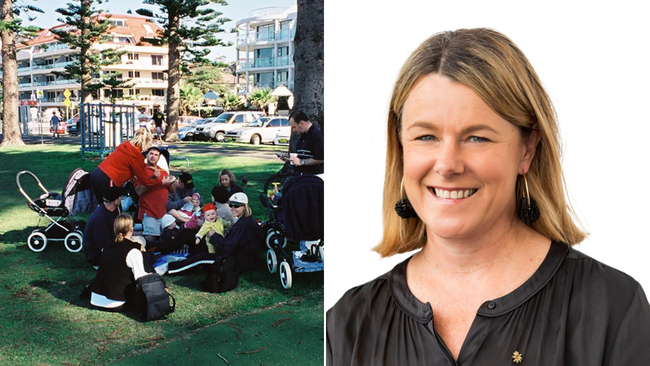
The death of a young mother 25 years ago who I knew affectionately as ‘Gidget’ changed the way Australia thinks about perinatal depression and anxiety.
When Louise died by suicide, leaving behind her husband and their nine-month-old daughter, we – her family and close friends – were not only devastated, but shocked that none of us knew she was struggling with motherhood.
To anyone looking in from the outside, Louise — or as we all called her ‘Gidget’ as she reminded us so much of the character from the television series — seemed to have it all.
Know the news with the 7NEWS app: Download today
She had married the love of her life, created a beautiful home and, after a long and challenging journey to conceive, welcomed the daughter she had dreamed of for so many years.
Looking back, her caring nature and perfectionist tendencies may have contributed to her silence about the struggles she experienced in motherhood.
Yet it was also a different time.
Twenty-five years ago, conversations about mental health were rare, and awareness of perinatal depression and anxiety (PNDA) was even more limited.
Before Gidget’s death, Australia largely viewed motherhood through a romantic lens.
We celebrated the baby but rarely asked how the mother was coping.
Exhaustion, anxiety, intrusive thoughts and feelings of despair were often dismissed as part of the adjustment to parenthood.
Women were expected to put on a brave face and be grateful, while many suffered in silence, afraid of being labelled a bad mother.
PNDA was poorly understood, specialised support was scarce and conversations about maternal mental health were virtually non-existent amongst parents as well as healthcare professionals.

For too many families, the struggle remained hidden until it reached crisis point.
Gidget’s story changed all that.
What began as a small gathering of Gidget’s sisters and friends coming together in grief to understand her death has evolved into Gidget Foundation Australia, a national organisation providing vital perinatal mental health support to thousands of Australians each year.
As Gidget Foundation Australia’s first president, I have witnessed remarkable progress over the past 25 years — not only within the Foundation itself and the services we provide but also in societal understanding of PNDA.
One of the things that has stayed with me most is how invisible Gidget’s suffering was.
Gidget’s mother reflected that she spoke with her daughter almost every day and that Gidget shared nearly every aspect of her life.
Yet there was one thing she could not bring herself to reveal — the depth of her distress.
As the foundation’s first president, I believed our role was not only to provide support for parents experiencing perinatal mental health challenges, but also to bring these issues out of the shadows.
We wanted to create a culture where parents felt safe to speak openly about their struggles and knew that asking for help was a sign of strength, not failure.

It was important that the silence that surrounds PNDA be broken.
This is to ensure parents are more likely to recognise the symptoms, healthcare professionals are better informed and seeking support becomes far more accepted.
While awareness of PNDA has improved dramatically, too many people still struggle in silence.
Recent Gidget Foundation Australia research found that 41 per cent of parents frequently feel they are not “good enough”.
One in three believe their symptoms are not severe enough to seek professional support.
Nearly one-third say they would have liked a healthcare professional to ask about their mental health during the perinatal period.
These figures concern me because they reveal a gap between awareness and action.
Parents may know that perinatal mental health conditions exist, but many still don’t believe their own struggles are serious enough to warrant support.
Even when parents do recognise the signs and symptoms, our healthcare system can sometimes let them down, whether through missed opportunities to identify distress or by focusing primarily on the baby’s wellbeing during postnatal check-ups.
Too often, the mother’s mental health can go unnoticed, leaving parents feeling isolated at a time when support is needed most.
Looking back, the biggest lesson from Gidget’s death is not about what we didn’t know. It is about the importance of asking questions and truly listening to the answers.
Mental illness doesn’t always look like crisis.
Sometimes it hides behind competence.
Sometimes it exists behind a smile.
Sometimes it is present in the very people we least expect.
As Gidget Foundation Australia marks its 25th anniversary, I am incredibly proud of how far Australia has come in recognising and supporting perinatal mental health.
Thousands of parents have accessed care and support that simply did not exist when Gidget became a mother.
While there is still more work to do, it is heartening to see greater awareness, understanding and willingness to seek help.
I am immensely proud that Gidget Foundation Australia has played a part in driving this change, ensuring that more parents receive the support they need, when they need it most.
About the author
Libby Bowditch is a founding member and was the first President of Gidget Foundation Australia. Libby was recently awarded the Medal of the Order of Australia (OAM) for service to the community through charitable initiatives in the 2026 Kings’s Birthday Honours List. She was a close friend of Gidget, a young mother who tragically died by suicide while experiencing postnatal depression. Libby’s current role with Gidget Foundation Australia encompasses event management and the design of Gidget Houses, utilising her public relations, events management and interior design skills. Libby has three adult children, together with her husband Jarrod, who was Gidget’s best friend.
About Gidget Foundation Australia
2026 marks Gidget Foundation Australia’s 25-year anniversary. Gidget Foundation Australia is a not-for-profit organisation that exists to support the mental health of families, from pre-conception through to early infancy, to ensure they receive accessible, timely and specialised care.
As the leading national provider of perinatal mental health services, Gidget Foundation Australia provides year-long, free individual and group perinatal mental health psychological therapy services delivered in-person and via telehealth.
Gidget Foundation Australia invests in its 200+ clinicians through innovative training, mentoring and supervision to meet growing demand.
To access perinatal mental health support – those affected need to speak to a GP about a referral and a Mental Health Treatment Plan or contact Gidget Foundation Australia’s Client Experience Team on 1300 GIDGET to discuss support options specific to their needs.
Although there have been incredible advances in perinatal mental health awareness, education and support since 2001, there is still so much more to do. Gidget Foundation Australia’s key focus for the next 25 years is to transform perinatal mental health for the next generation.
For further information and helpful resources visit gidgetfoundation.org.au.


